Most businesses do not have a customer communication problem.
They have a coordination problem.
The email arrives. Someone replies. A technical issue gets forwarded. The customer follows up because nobody appears to own the problem. A salesperson gets involved. Support is copied into the thread. Operations discovers that something needs to be done internally. A manager enters the conversation because the customer is becoming frustrated.
Eventually, the issue gets resolved.
But it may have taken five people, three systems, two inboxes, and a collection of messages to accomplish something that should have been straightforward.
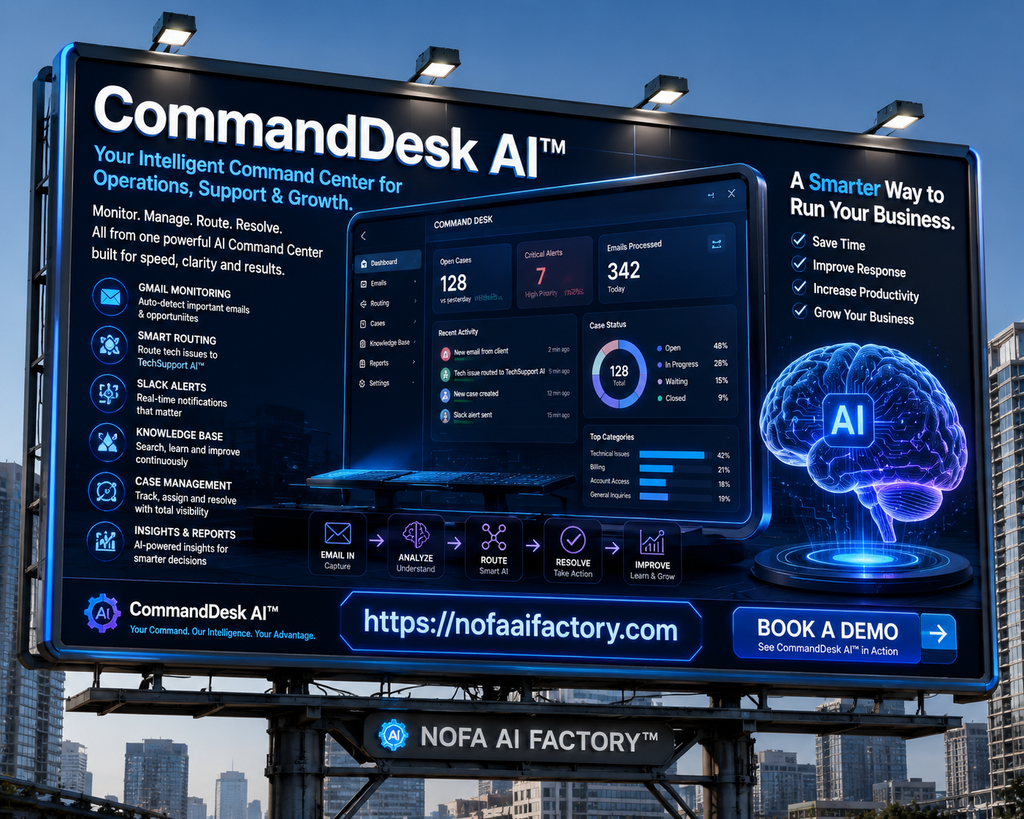
This is the environment CommandDesk AI™ is designed for.
Developed through NOFA AI Factory™, CommandDesk AI™ is a customizable AI-powered customer command center designed to sit between incoming customer communication and the people, systems, workflows, and specialized AI assistants responsible for taking action.
Its purpose is not merely to answer customers faster.
Its larger purpose is to help a business operate as one coordinated system.
Customer service has become an operations problem
The modern customer can enter a business through almost anywhere.
They may send an email in the morning, submit a website form that afternoon, report a technical problem the following day, and later contact someone else at the company because they are unsure whether the original issue is being handled.
From the customer’s perspective, all of those interactions are with the same company.
Inside the company, however, they may enter completely different systems.
The website form goes to marketing.
The email goes to a shared inbox.
The technical problem goes to support.
The salesperson keeps notes somewhere else.
An operational request becomes a task in another system.
Management may know nothing about the situation until something goes wrong.
This fragmentation creates one of the least visible costs in business: coordination overhead.
Employees spend time figuring out who owns a request, searching for context, forwarding information, asking whether someone responded, copying coworkers into conversations, recreating information that already exists, and trying to determine what still needs to happen.
Customers experience that internal complexity as delay.
CommandDesk AI™ approaches the problem from the opposite direction.
Instead of requiring the customer to understand the organization, the organization should understand the customer.
Start with intent, not the inbox
Suppose a customer writes:
“We installed the system yesterday, but the dashboard isn’t connecting to our account. We have a presentation with management at 2:00 this afternoon and need to get this working.”
An ordinary inbox sees a message.
CommandDesk AI™ can potentially see an operational situation.
This is an existing customer. The request appears technical. There is a connection problem. There is an explicit time constraint. The customer needs assistance before an important presentation.
Those details determine what should happen next.
If the problem can be answered safely from approved support information, AI may provide immediate guidance.
If the issue requires specialized troubleshooting, it can be routed to TechSupport AI™.
If human technical support is necessary, the appropriate person or team can receive the request along with the relevant context.
The intelligence is not simply:
“What should I say to the customer?”
It is:
“What does this customer need, who or what should handle it, and how do we make sure it gets done?”
That is a fundamentally different product.
The customer should not need an organizational chart
Businesses often make customers navigate their internal structure.
For sales, contact this person.
For billing, use this email address.
For support, open this form.
For technical problems, go somewhere else.
For an account question, contact your representative.
For an urgent issue, call another number.
This structure may make perfect sense to the company.
It makes considerably less sense to the customer.
A customer usually does not care which department owns the problem. The customer cares whether the problem gets solved.
CommandDesk AI™ can become an intelligent front door.
The customer explains what they need.
The system interprets the request.
The appropriate workflow begins behind the scenes.
That is what good orchestration should feel like: the complexity exists, but the customer does not have to manage it.
What happens after AI answers?
This may be the most important question in the entire product.
Conversational AI has become increasingly good at responding to questions. But businesses do not operate on conversations alone.
A customer says:
“Yes, I’d like someone to call me tomorrow.”
The chatbot says:
“Certainly!”
And then what?
Did a task get created?
Who owns it?
Does someone know the customer is waiting?
What happens if nobody calls?
Will the system notice?
This is the point where many conversational experiences stop—and where CommandDesk AI™ begins to become more interesting.
A customer interaction can create an operational obligation.
That obligation may need an owner, status, priority, deadline, escalation rule, and resolution.
In other words, the conversation should be capable of becoming work.
CommandDesk AI™ is designed around that continuation.
A request arrives. AI understands it. The customer receives an appropriate response. If additional action is required, the work is routed. Its status remains visible. If necessary, it escalates. Eventually, the request reaches resolution.
The customer conversation and the operational workflow are no longer separate worlds.
This is where TechSupport AI™ fits
Imagine CommandDesk AI™ as the control tower rather than every aircraft.
It does not need to perform every specialized task itself.
When an incoming request is technical, CommandDesk AI™ can coordinate with TechSupport AI™, a specialized AI system designed around technical troubleshooting and support escalation.
The distinction is useful.
CommandDesk AI™ understands the customer interaction and determines that technical assistance is required.
TechSupport AI™ handles the specialized troubleshooting workflow.
If the issue exceeds AI’s appropriate scope, a human specialist takes over.
The customer does not need to know which AI engine, department, or internal workflow is operating behind the scenes.
They simply need help.
This modular approach also creates a larger possibility for businesses adopting multiple AI systems.
The next business problem may be AI fragmentation
For years, companies have struggled with software fragmentation.
One platform handles CRM.
Another handles support.
Another handles accounting.
Another handles scheduling.
Another handles project management.
Now businesses are beginning to add AI.
One AI handles customer conversations.
Another handles technical support.
Another analyzes documents.
Another manages sales prospects.
Another helps with operations.
Another schedules appointments.
Without orchestration, businesses could simply replace software fragmentation with AI fragmentation.
That creates a new question:
Who coordinates the AI?
CommandDesk AI™ can potentially become part of that answer.
Rather than expecting a customer or employee to determine which AI assistant should handle something, the command layer can determine the appropriate pathway.
The customer describes the need.
CommandDesk understands the intent.
The correct resource receives the task.
That resource might be AI.
It might be software.
It might be a human.
Or it might involve all three.
The architecture becomes less about building one giant AI that supposedly does everything and more about coordinating specialized intelligence.
A morning dashboard should tell management a story
Picture a business owner opening CommandDesk AI™ at 8:00 AM.
The most useful dashboard would not simply announce:
You have 63 unread messages.
That creates work.
A command center should create understanding.
It might reveal that most overnight questions were answered successfully, several customers require human follow-up, two technical incidents remain unresolved, one high-value prospect requested a demonstration, and an existing customer’s repeated support issue is approaching an escalation threshold.
Now management sees the operational condition of customer activity.
The dashboard is not an inbox.
It is closer to a customer operations control tower.
That distinction becomes increasingly valuable as an organization grows.
The owner no longer needs to read every conversation to understand whether customers are being taken care of.
Small businesses may benefit the most
Large companies can build entire departments around coordination.
They have customer-service teams, help desks, CRM administrators, account managers, operations managers, escalation procedures, ticketing systems, and analytics departments.
A small company may have six employees.
The owner may also be the salesperson.
The office manager may handle customer support.
Someone in operations may answer billing questions because they happen to know the answer.
The same employee may monitor three inboxes while performing their actual job.
That does not mean the smaller business needs less coordination.
It means it has fewer people available to perform it.
CommandDesk AI™ could give a smaller organization an intelligent operational layer without requiring it to immediately create the administrative structure of a large enterprise.
Routine questions can be handled automatically within approved boundaries.
Incoming requests can be classified.
Messages can be summarized.
Work can be routed.
Outstanding issues can remain visible.
Humans can concentrate on the interactions where human judgment actually matters.
This is not simply about reducing labor.
It is about increasing the operational capacity of the people already there.
Growing companies face the problem differently
At ten customers, everyone remembers everything.
At fifty customers, people still know most of what is happening.
At five hundred, informal coordination begins to fail.
The founder cannot read every email.
Employees develop different procedures.
Customer history becomes scattered.
One department cannot see what another promised.
Important information becomes trapped in personal inboxes.
This is a natural consequence of growth.
The company has not necessarily become worse at customer service.
It has become more complex than its original operating system can handle.
CommandDesk AI™ can provide structure at precisely that transition.
Customer messages contain business intelligence
There is another layer to CommandDesk AI™ that may eventually prove as valuable as automation.
Customers constantly tell companies what is wrong with their businesses.
They just do not put it into a management report.
They put it into emails, support requests, chats, complaints, questions, and conversations.
Imagine that 37 customers ask essentially the same onboarding question in one month.
That may not be a support problem.
It may be an onboarding-design problem.
Suppose questions about pricing suddenly increase.
Perhaps the website is unclear.
Suppose complaints involving one product feature triple after a software update.
That could indicate a product issue.
Suppose customers repeatedly ask when someone will call them back.
That could expose a workflow failure.
CommandDesk AI™ can potentially help aggregate these interactions into patterns.
Customer communication then becomes a source of operational intelligence.
The business can begin asking not only:
“Did we answer the customer?”
but also:
“What are our customers collectively telling us about the way our company operates?”
That is a much more valuable question.
Speed is useful. Context is better.
Businesses understandably want faster response times.
But customer experience is not measured only in seconds.
Consider an existing customer who has contacted the company three times about the same issue.
An immediate generic response may actually make the experience worse.
What the customer wants is evidence that the company remembers.
A more intelligent system can potentially understand:
This customer contacted us previously.
The earlier issue was not fully resolved.
The current message relates to the same problem.
The customer is becoming frustrated.
A human should probably review this.
That is not simply faster customer service.
It is context-aware customer service.
With appropriate permissions, privacy protections, and data governance, CommandDesk AI™ can help create an operational memory that follows the relationship rather than remaining trapped in individual conversations.
AI should not handle everything
There is a temptation to measure an AI customer-service platform by how few humans it requires.
That is the wrong metric.
Some customer interactions should reach people.
A frustrated long-term customer may need a human conversation.
A complex contract issue may require judgment.
A sensitive complaint may require management.
A technical incident may require an engineer.
A major sales opportunity may deserve an experienced salesperson.
CommandDesk AI™ should therefore be judged partly by whether it knows when not to continue autonomously.
The operating philosophy should be:
Automate the routine. Coordinate the complex. Escalate the important.
That preserves human involvement where it creates the greatest value.
Customization is what turns a platform into a business command center
A hotel and a software company do not operate the same way.
Neither does a property-management company, consulting firm, contractor, distributor, healthcare organization, retailer, nonprofit, or professional-services firm.
Their customers ask different questions.
Their departments are different.
Their escalation rules are different.
Their definitions of urgency are different.
Their workflows are different.
CommandDesk AI™ is therefore designed as a customizable system rather than a single fixed customer-service script.
The organization defines its knowledge, services, workflows, departments, routing rules, escalation paths, operating procedures, and AI responsibilities.
The intelligence is then configured around the business.
That is an important difference between adding a chatbot and building an AI operational layer.
Judy talks. CommandDesk coordinates.
Within the broader NOFA AI ecosystem, CommandDesk AI™ can complement JudyVA™.
JudyVA™ can become the conversational interface.
Customers can ask questions, explain problems, request assistance, or interact naturally with the business.
Behind that conversation, CommandDesk AI™ can help coordinate what needs to happen.
This creates a useful division of responsibility:
JudyVA™ communicates. CommandDesk AI™ coordinates. Specialized AI systems execute within their areas. Humans intervene where judgment and relationships matter.
That begins to look less like a collection of AI tools and more like an AI-enabled operating model.
The real product may be orchestration
At first glance, CommandDesk AI™ appears to be a customer-service product.
Look deeper and the concept becomes broader.
Customer service is simply where the operational signal begins.
The customer asks for something.
The organization must respond.
Responding may require communication, technical support, scheduling, operations, sales, billing, management, or another business function.
CommandDesk AI™ sits at that intersection.
Its potential value is not that it becomes the smartest chatbot.
Its value is that it can help coordinate the movement from request to resolution.
That makes orchestration the more interesting idea.
What CommandDesk AI™ is—and what it isn’t
CommandDesk AI™ is a customizable AI-powered customer operations command center designed to understand incoming customer requests, provide approved responses where appropriate, coordinate specialized AI systems and human teams, track operational workflows, and keep unresolved customer needs visible.
It should not invent policies.
It should not make unauthorized promises.
It should not pretend a problem has been resolved simply because a response was generated.
It should not conceal important issues from human employees.
And it should not be given unlimited authority simply because AI is capable of acting quickly.
The organization defines the boundaries.
AI operates inside them.
Humans retain authority where authority belongs.
The question businesses should ask
For years, companies have asked:
“How can we answer customers faster?”
That is still worth asking.
But CommandDesk AI™ introduces a larger question:
“How can we make sure every important customer request becomes the right action—and stays visible until something actually happens?”
That is the difference between answering messages and running customer operations.
And as businesses add more channels, more automation, and more specialized AI assistants, that distinction will become increasingly important.
CommandDesk AI™ is being developed around a simple idea:
The customer should not have to manage the complexity of your business. Your business should manage the complexity for the customer.
That is what a command center is supposed to do.
CommandDesk AI™ — A NOFA AI Factory™ Innovation
CommandDesk AI™ follows the prototype-first development philosophy of NOFA AI Factory™: identify a real operational problem, turn the idea into a working model, test it, gather feedback, validate the value, and then determine what deserves production-level development.
The goal is not another inbox.
The goal is an intelligent layer capable of helping a business understand what customers need, coordinate what should happen next, and keep the organization moving toward resolution.
CommandDesk AI™ — When the customer asks, the business moves.
Explore more working AI ideas, products, and prototypes through the NOFA AI Factory™ Showroom.
NOFA AI Factory™ — We build AI that matters.
Ask Judy: https://usejudy.com

No comments:
Post a Comment