Opinion / Editorial
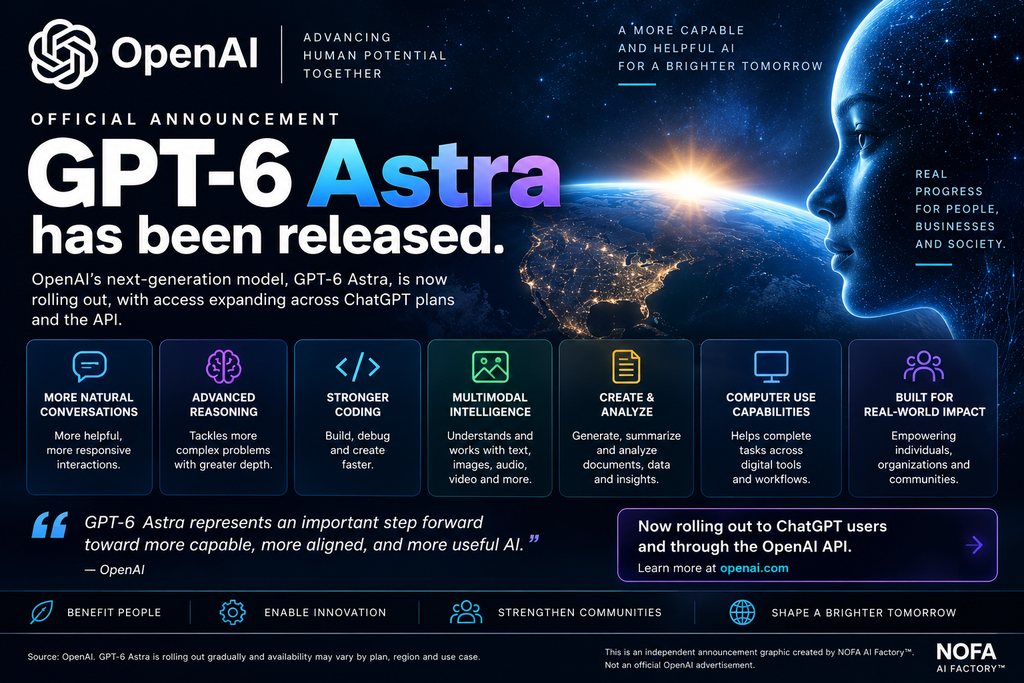
GPT-6 Astra is here, and the numbers are extraordinary.
OpenAI describes Astra as its most capable model, built for complex end-to-end work across reasoning, coding, computer use, research, science, cybersecurity, and professional workflows. It carries a 1.05-million-token context window, supports up to 128,000 output tokens, and is specifically designed to handle long, multi-step assignments rather than simply respond to individual prompts.
Those capabilities deserve attention.
But businesses are about to make the same mistake they have made with nearly every major AI release:
They will confuse access to a better model with having a better AI strategy.
They are not the same thing.
Everyone Will Eventually Have the Same Model
GPT-6 Astra is initially rolling out gradually, but OpenAI has announced broader availability across ChatGPT Plus, Pro, Business, Enterprise, and the API.
That means access itself will not remain a meaningful competitive advantage.
Your competitor can use Astra.
Your customer can use Astra.
A startup with three employees can use Astra.
A multinational corporation can use Astra.
If everyone has access to roughly the same underlying intelligence, the question changes.
The important question is no longer:
“Which AI model are you using?”
It becomes:
“What have you built around it?”
That is where the real competition begins.
A Smarter Model Does Not Automatically Create a Smarter Business
A company can give GPT-6 Astra to 500 employees tomorrow and still have inefficient operations next month.
Why?
Because the model does not automatically know the company’s objectives, workflows, approval processes, customers, proprietary knowledge, operational constraints, or business strategy.
Someone still has to architect the system.
A powerful model becomes far more valuable when it is connected to:
persistent memory,
company data,
specialized tools,
business rules,
APIs,
workflow automation,
validation systems,
monitoring,
human approval,
and other specialized AI agents.
The intelligence of the model matters.
The architecture surrounding that intelligence may matter even more.
The Future Is Not One Giant Chatbot
For the past several years, businesses have largely experienced artificial intelligence through a chat window.
Ask a question.
Receive an answer.
Ask another question.
GPT-6 Astra signals how quickly that paradigm is becoming outdated.
OpenAI is explicitly positioning Astra for complex workflows involving computers, browsers, coding environments, research, professional software, and long-running tasks. It can also continue reasoning while external tools execute and can incorporate new instructions while work is underway.
That is much closer to an AI worker than a traditional chatbot.
And once models operate as workers, another architectural shift becomes possible:
Instead of one AI doing everything, organizations can create teams of specialized agents.
One researches.
Another plans.
Another builds.
Another tests.
Another challenges the assumptions.
Another validates the result.
Another deploys it.
The underlying model supplies intelligence.
The agent system supplies organization.
That distinction could become enormously important.
The Next AI Race Is an Architecture Race
Imagine two companies using exactly the same GPT-6 Astra model.
Company A gives employees access to a chatbot.
Company B builds an autonomous system containing a research agent, planning agent, development agent, market intelligence agent, financial agent, quality-control agent, and validation agent.
Those organizations technically have access to the same model.
They do not have remotely the same capability.
Company B has transformed an AI model into an operational intelligence system.
That is why I believe the next major competitive battleground in artificial intelligence will not simply be model versus model.
It will be:
AI system versus AI system.
Who has the better memory architecture?
Who has the better agent orchestration?
Who has the better proprietary data?
Who has the better validation system?
Who can allow agents to collaborate effectively?
Who can turn a business objective into autonomous execution?
Who can build institutional intelligence that improves rather than disappears at the end of every conversation?
Those questions will separate AI adoption from genuine AI transformation.
GPT-6 Astra Also Raises the Stakes
There is another side to this progress.
Astra is the first OpenAI model designated at the Critical cybersecurity capability level under OpenAI’s Preparedness Framework. OpenAI says the model, when provided appropriate tools and access, demonstrated the ability to discover previously unknown vulnerabilities and develop sophisticated exploit chains, leading the company to deploy stronger safeguards and monitoring.
That is not a minor milestone.
It demonstrates something much larger:
As AI models become more capable, permissions, governance, monitoring and control become part of the product architecture itself.
An autonomous AI workforce cannot simply be given unlimited access to every system and told:
“Go accomplish the objective.”
The more capable the intelligence becomes, the more carefully organizations must define what it can access, what it can change, what requires validation and what requires human authorization.
Intelligence without architecture becomes unreliable.
Autonomy without governance becomes dangerous.
We Are Approaching the AI Factory Era
The most interesting consequence of GPT-6 Astra may therefore have little to do with chatting with a smarter AI.
It may be the acceleration of something much larger:
AI systems capable of producing other AI systems.
A sufficiently capable agent architecture could research an opportunity, evaluate the market, define requirements, design software, generate code, test the application, find defects, correct them, prepare documentation, deploy a prototype and then monitor its performance.
Humans would increasingly move from performing every step to defining objectives, setting constraints and approving important decisions.
That changes the economics of software creation.
It changes consulting.
It changes entrepreneurship.
It changes what a small organization can build.
And it may eventually change the definition of a company itself.
GPT-6 Is Not the Finish Line
Every major model release generates the same reaction:
“This changes everything.”
GPT-6 Astra certainly changes a great deal.
But the biggest opportunity is not simply using GPT-6.
The opportunity is building systems that multiply what GPT-6 can do.
The companies that win the next stage of artificial intelligence will not necessarily be the ones with the most employees, the largest IT departments or even the earliest access to the newest model.
They may be the companies that figure out how to assemble models, agents, memory, tools, data, validation and automation into functioning digital organizations.
GPT-6 Astra provides a more powerful engine.
Now the real question is who builds the better machine around it.

No comments:
Post a Comment