EduWing™: The Problem Isn’t a Lack of Educational Content. It’s a Lack of Personalized Help When a Student Needs It.
A seventh-grade student is sitting at the kitchen table struggling with fractions.
The teacher explained the concept earlier that day.
The textbook contains another explanation.
There are videos online.
There may even be practice exercises available.
But none of that necessarily solves the student’s immediate problem:
“I still don’t understand it. Can someone explain it differently?”
That question reveals one of the persistent problems in education.
The world has more educational content than ever before. Students can access textbooks, videos, websites, courses, worksheets, tutorials, and search engines.
But access to information is not the same as access to personalized instruction.
A student may need the same concept explained three different ways. Another may understand immediately but need more challenging practice. A child learning in a second language may understand the mathematics but struggle with the English explanation. A parent may want to help but no longer remember the subject well enough. A teacher may recognize exactly what a student needs but have 25 other students requiring attention.
This is the problem EduWing™ was designed to address.
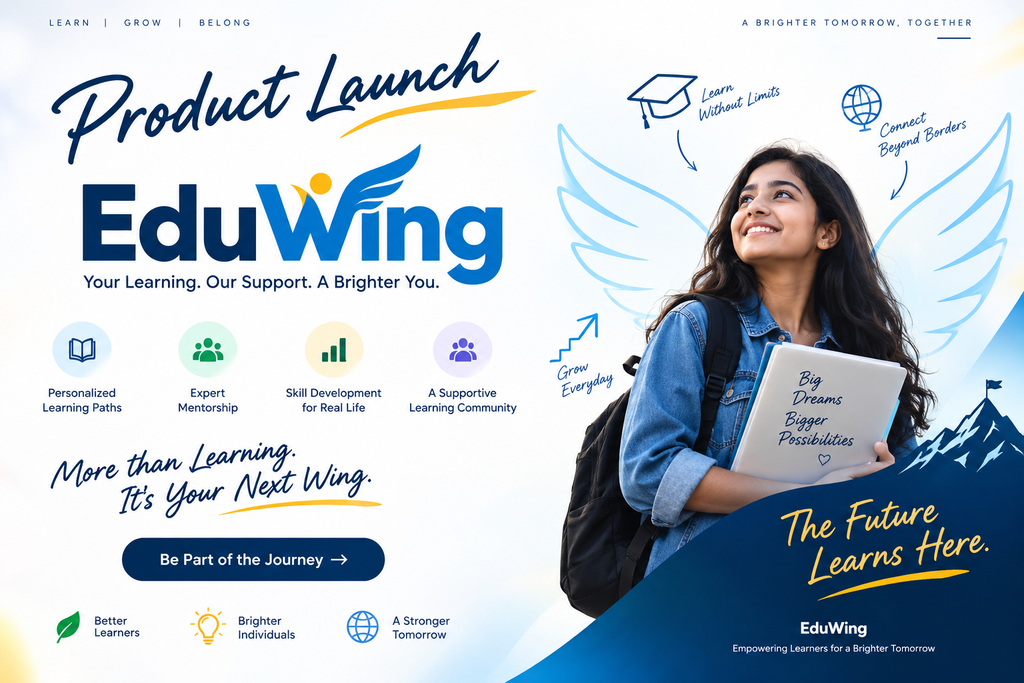
Developed through NOFA AI Factory™, EduWing™ is an AI-powered educational assistant designed to provide personalized learning support for students from Kindergarten through Grade 12.
The objective isn’t to replace teachers, schools, parents, or classroom instruction.
It is to address something those systems cannot always provide:
Individualized educational help at the exact moment a student needs it.
Problem #1: One Classroom, Many Different Learners
A teacher may explain one concept to an entire class.
But the students receiving that explanation are not identical.
One student already understands.
Another almost understands.
A third has a knowledge gap from the previous year.
A fourth learns better through examples.
A fifth needs the explanation broken into smaller steps.
Another may be afraid to admit that they are lost.
And another may understand the subject but struggle with the language being used to teach it.
Yet traditional classroom instruction must operate within practical limits.
One teacher cannot simultaneously deliver 25 individually customized versions of every lesson.
The EduWing™ solution
EduWing™ is designed to adapt explanations to the student’s grade level, learning needs, and language.
A student doesn’t simply ask:
“What is photosynthesis?”
The educational assistant can consider whether the learner is in third grade, seventh grade, or high school.
The underlying concept may be the same.
The explanation should not be.
For a younger student, the system may begin with a simple analogy.
For an older student, it can introduce more scientific terminology and biological mechanisms.
If the student still doesn’t understand, EduWing™ can try another explanation.
That is the advantage of individualized AI assistance:
The lesson can adapt to the learner instead of requiring every learner to adapt to one explanation.
Problem #2: Students Need Help Outside School Hours
Learning problems don’t occur according to a school schedule.
A student may begin homework at 7:30 PM.
The teacher isn’t available.
The tutoring center is closed.
A parent may be working.
A test may be tomorrow morning.
The student encounters one difficult problem and gets stuck.
Sometimes that single obstacle stops the entire study session.
The EduWing™ solution
EduWing™ is designed to provide educational support when the student needs it.
After school.
In the evening.
On weekends.
During independent study.
While preparing for a quiz.
While reviewing something forgotten from an earlier grade.
The purpose isn’t to create an AI that simply gives students answers.
A useful tutor should help students reach the answer through understanding.
That means explaining concepts, asking guiding questions, offering examples, creating practice exercises, and checking comprehension.
The goal is learning—not homework completion by proxy.
Problem #3: “I Don’t Understand” Often Means “Explain It Differently”
This may be one of the most important problems EduWing™ addresses.
Suppose a student doesn’t understand a mathematics concept.
Repeating the exact same explanation more slowly may not help.
The student might need:
A visual analogy.
A real-world example.
A simpler problem first.
A step-by-step explanation.
A comparison with something already understood.
A practice question.
Or an explanation in another language.
Good tutoring is adaptive.
It asks:
“Where did understanding break down?”
The EduWing™ solution
EduWing™ can treat the first explanation as the beginning of the interaction rather than the end.
Conceptually:
Explain → Check Understanding → Detect Difficulty → Reframe → Practice → Check Again
If the student still struggles, the system changes its approach.
That is fundamentally different from a static textbook page or prerecorded video.
Problem #4: Students Are Often Embarrassed to Ask Questions
There is another barrier to learning that has nothing to do with intelligence.
Students sometimes don’t ask for help because they are embarrassed.
They don’t want classmates to think they are behind.
They don’t want to ask the teacher the same question again.
They think everyone else understands.
They fear that their question is “stupid.”
So they remain quiet.
The misunderstanding remains.
Then the next lesson builds on the concept they never mastered.
One small gap becomes a larger one.
The EduWing™ solution
An AI tutor creates a different environment.
A student can ask:
“I still don’t get it.”
Then ask again.
And again.
There is no embarrassment.
No impatient classmate.
No concern about holding up the lesson.
EduWing™ can respond:
Let’s try another way.
That psychological freedom to keep asking questions may be one of AI tutoring’s most useful characteristics.
Curiosity works better when students aren’t afraid to expose confusion.
Problem #5: Homework Help Can Easily Become Answer Giving
This is one of the biggest design challenges for educational AI.
A student takes a picture of a homework problem and asks:
“What’s the answer?”
The easiest thing for AI to do is provide it.
But the fastest answer isn’t necessarily the best educational response.
If AI completes the reasoning for the student every time, it can undermine the very learning it is supposed to support.
The EduWing™ solution
EduWing™ should be designed around guided learning rather than automatic completion.
Depending on the student’s age and task, it can begin with:
“Let’s work through this together.”
Then identify the concept.
Ask the student what they already know.
Provide a hint.
Work through an intermediate step.
Ask the student to attempt the next step.
Explain an error.
Provide another practice problem.
This changes the AI’s role from:
Answer Machine
to:
Learning Partner
That distinction should remain central to EduWing™.
Problem #6: Language Can Become a Barrier to Learning
A student may be capable of understanding a concept but unable to understand the language used to explain it.
This matters around the world.
It also matters inside multilingual communities.
Imagine a student who is learning science in English but speaks Spanish, Farsi, Arabic, Korean, French, or another language more comfortably at home.
The student may understand the scientific idea much faster if the difficult portion can first be clarified in a familiar language.
The EduWing™ solution
EduWing™ is designed with multilingual learning as a core capability rather than an afterthought.
A student could ask a question naturally through text or voice and receive help in a preferred supported language.
The system could potentially explain the underlying concept in that language while also helping the student learn the terminology used in the classroom.
This creates an important educational bridge:
Understanding the subject and developing proficiency in the instructional language do not have to be competing goals.
AI can potentially support both.
Problem #7: Tutoring Is Valuable—but Not Equally Accessible
Personal tutoring can be highly useful.
It can also be expensive, geographically unavailable, difficult to schedule, or simply beyond the resources of many families.
This creates an educational inequality.
Some students can receive individualized help several times a week.
Others rely entirely on whatever assistance is available during school.
And in underserved communities, even basic educational resources may be limited.
The EduWing™ solution
EduWing™ is designed around a larger accessibility idea:
A student’s access to individualized educational support should not depend entirely on geography or family resources.
AI doesn’t eliminate the digital divide.
Students still need appropriate devices, connectivity, safe access, and suitable educational infrastructure.
Nor does an AI tutor automatically reproduce everything an excellent human tutor provides.
But once access is available, software can distribute individualized assistance at a scale traditional one-to-one tutoring cannot easily achieve.
That creates significant potential for students in underserved communities and regions where specialized educational resources are limited.
Problem #8: Parents Want to Help but Can’t Be Experts in Every Subject
A parent hears:
“Can you help me with my algebra?”
The parent looks at the problem.
It has been 25 years since they studied algebra.
Or chemistry.
Or geometry.
Or grammar rules.
Or whatever subject happens to be tonight’s homework.
Parents may care deeply about their child’s education without having the subject knowledge—or the teaching technique—to explain every lesson.
The EduWing™ solution
EduWing™ can become an additional support layer.
The student gets immediate academic guidance.
The parent doesn’t have to become the household expert in every K–12 subject.
And where appropriate, the AI could help parents understand the concept being studied so they can better support the child’s learning.
That changes the dynamic from:
Parent must know the answer
to:
Parent can help create the conditions for learning.
Problem #9: Teachers Cannot Provide Unlimited Individual Attention
Teachers already perform one of the most complex forms of knowledge work.
They explain.
Assess.
Plan.
Encourage.
Correct.
Differentiate.
Manage classrooms.
Communicate with families.
Identify struggling students.
Support advanced learners.
And much more.
AI tutoring should not be positioned as a substitute for that work.
The more useful question is:
Which repetitive forms of individualized reinforcement could AI provide so teachers can concentrate more attention where human expertise matters most?
The EduWing™ solution
EduWing™ can potentially complement classroom instruction by providing additional practice and explanations outside the teacher’s limited one-to-one time.
The model becomes:
Teacher teaches and guides.
Student practices.
EduWing™ reinforces and adapts.
Teacher remains central to the educational relationship.
That is a much stronger model than “AI replaces teachers.”
Problem #10: Students Can Practice Without Knowing What They Actually Understand
A student completes 20 questions.
They get 14 correct.
What does that tell us?
Something.
But not enough.
Perhaps all six mistakes involve the same concept.
Perhaps several correct answers were guesses.
Perhaps the student understands the basic problem but struggles when it is presented differently.
Perhaps a prerequisite concept is missing.
The educational value comes from identifying the pattern.
The EduWing™ solution
An adaptive tutoring system can use practice not merely as a score but as a source of learning information.
The loop becomes:
Question → Response → Pattern → Feedback → Targeted Practice → Reassessment
Instead of simply saying:
14/20 — 70%
EduWing™ could help the student understand:
“You’re doing well with multiplication of fractions, but division of fractions is still causing difficulty. Let’s focus there.”
Now practice becomes diagnostic.
The Real Problem Is Not Information Scarcity
This is the central idea behind EduWing™.
A student can search the internet and find thousands of pages about fractions.
Or photosynthesis.
Or the American Revolution.
Or Shakespeare.
Or chemistry.
The internet solved much of the information-access problem.
It did not solve the individual-learning problem.
Students still need to know:
What should I learn next?
Why don’t I understand this?
Can you explain it differently?
Can I practice?
Was my answer wrong because I don’t understand the concept or because I made a small mistake?
Am I ready to move on?
Those are tutoring questions.
EduWing™ is designed around them.
From Content Delivery to a Learning Conversation
Traditional digital education often looks like:
Search → Read → Watch → Practice
EduWing™ introduces a conversational loop:
Ask
↓
Explain
↓
Check Understanding
↓
Practice
↓
Identify Difficulty
↓
Adapt
↓
Try Again
↓
Build Mastery
That last word matters.
The goal shouldn’t be simply engagement.
It shouldn’t be how many questions the student asked.
Or how long the student remained in the application.
The educational objective is understanding and progress.
Voice Changes the Experience for Younger Learners
Text-based AI is powerful.
But not every K–12 student should be expected to communicate with a tutor through a keyboard.
For younger learners especially, voice can make the interaction much more natural.
A child can simply ask:
“Why does the moon change shape?”
And EduWing™ can respond conversationally at an appropriate level.
The child asks another question.
Then another.
That creates something closer to a tutoring conversation than a search session.
Voice can also improve accessibility for students who struggle with typing, spelling, or other aspects of text interaction.
The interface should adapt to the learner—not become another barrier.
The System Must Know That a Kindergartner Is Not a High School Senior
This sounds obvious.
For AI education, it is fundamental.
An explanation can be factually correct and still be educationally inappropriate.
Too complex and the student becomes lost.
Too simple and the student learns very little.
So grade level should affect more than vocabulary.
It should influence:
Explanation depth.
Examples.
Question complexity.
Expected prior knowledge.
Practice difficulty.
Interaction style.
Amount of guidance.
EduWing™ therefore isn’t simply a general chatbot with an education label.
The educational layer needs to shape how the AI teaches.
Safety Matters More When the User Is a Child
K–12 AI requires additional responsibility.
A system serving children needs strong safeguards around privacy, age-appropriate interactions, content boundaries, data handling, and the role of parents, educators, and schools.
It should not manipulate students into remaining online.
It should not pretend to be a human teacher or friend.
It should not encourage dependency.
It should not confidently invent academic facts.
And it should be clear when information is uncertain or when a student needs help from a teacher, parent, or other appropriate adult.
The standard cannot simply be:
Did the AI answer?
The standard should include:
Was the answer appropriate for this learner and this context?
EduWing™ Should Help Build Confidence Without Creating False Confidence
Students need encouragement.
But encouragement should not mean telling students they understand something when they don’t.
A good educational assistant can say:
“You’re improving. You handled the first two steps correctly. Let’s work on the final step.”
That’s very different from:
“Perfect! You’ve mastered this!”
when the evidence doesn’t support it.
Confidence should emerge from demonstrated progress.
That makes practice, feedback, and reassessment important components of personalized tutoring.
A Student in Maryland and a Student Thousands of Miles Away May Need the Same Thing
The geography may be different.
The school systems may be different.
The language may be different.
The available resources may be dramatically different.
But the moment of confusion is universal:
“I don’t understand.”
That is why EduWing™ has global potential.
The underlying educational need isn’t limited to one school district or country.
Students everywhere need explanations.
Practice.
Encouragement.
Feedback.
Repetition.
And sometimes they simply need someone—or something—to patiently try another way.
Multilingual AI makes it increasingly possible to provide that layer across geographic and linguistic boundaries.
EduWing™ Doesn’t Need to Replace the Classroom to Matter
Some of the most useful AI products won’t replace existing institutions.
They will fill the gaps between them.
EduWing™ can operate:
Between classes.
Between tutoring sessions.
Between homework questions.
Between a student’s confusion and the next opportunity to ask a teacher.
That may be exactly where educational AI can create meaningful value.
The teacher remains.
The classroom remains.
The curriculum remains.
The parent remains.
But the student gains another layer of support.
The Problem EduWing™ Ultimately Solves
Education has always faced a difficult constraint:
Learning is individual, but educational resources must often be delivered at scale.
Teachers teach groups.
Textbooks are printed for groups.
Videos are recorded for groups.
Curricula are designed for groups.
But understanding happens inside one learner at a time.
EduWing™ is designed to help bridge those two realities.
The system takes scalable AI and uses it to create a more individualized educational interaction:
One student.
One question.
One explanation.
One learning gap.
One next step.
And then it repeats.
From “Here’s the Lesson” to “What Do You Need Next?”
That may ultimately be the most important change.
Traditional education technology often begins with content:
“Here is today’s lesson.”
Personalized AI tutoring can begin with the learner:
“What are you trying to understand?”
Then adapt from there.
That doesn’t eliminate curriculum, standards, teachers, or structured education.
It adds another capability:
Responsive educational support.
The student doesn’t simply receive information.
The system interacts with the student’s understanding.
And that is the problem EduWing™ is designed to solve.
EduWing™ — A NOFA AI Factory™ Innovation
EduWing™ is an AI-powered educational assistant designed to provide personalized K–12 tutoring across academic subjects through text and voice.
It can help students reinforce classroom learning, work through homework concepts, prepare for quizzes, practice skills, explore new subjects, and receive explanations adapted to their grade level and preferred supported language.
It is designed to support—not replace—teachers, parents, schools, and appropriate human educational guidance.
The larger vision is simple:
High-quality educational support should become easier to reach when a student needs it, wherever that student happens to be.
Because sometimes the difference between giving up and understanding is simply hearing:
“Let’s try explaining it another way.”
EduWing™ — Personalized learning. One student at a time.
NOFA AI Factory™ — We build AI that matters.

No comments:
Post a Comment