A business idea can happen in seconds.
Building a real company around it can take months.
An entrepreneur recognizes a problem and thinks:
“There should be software for this.”
Then reality begins.
What exactly should the product do?
Who would buy it?
Is the problem important enough to solve?
What features belong in the first version?
What should wait?
How should the software be architected?
What AI model should it use?
Does it need authentication?
A database?
Payments?
An admin dashboard?
APIs?
Voice?
Email?
Analytics?
Security?
What should the interface look like?
What instructions would a developer need?
And perhaps the most important question:
Should this product even be built?
This gap between having an idea and having a buildable startup is where many promising concepts die.
AI Startup Factory™ is designed to attack that gap.
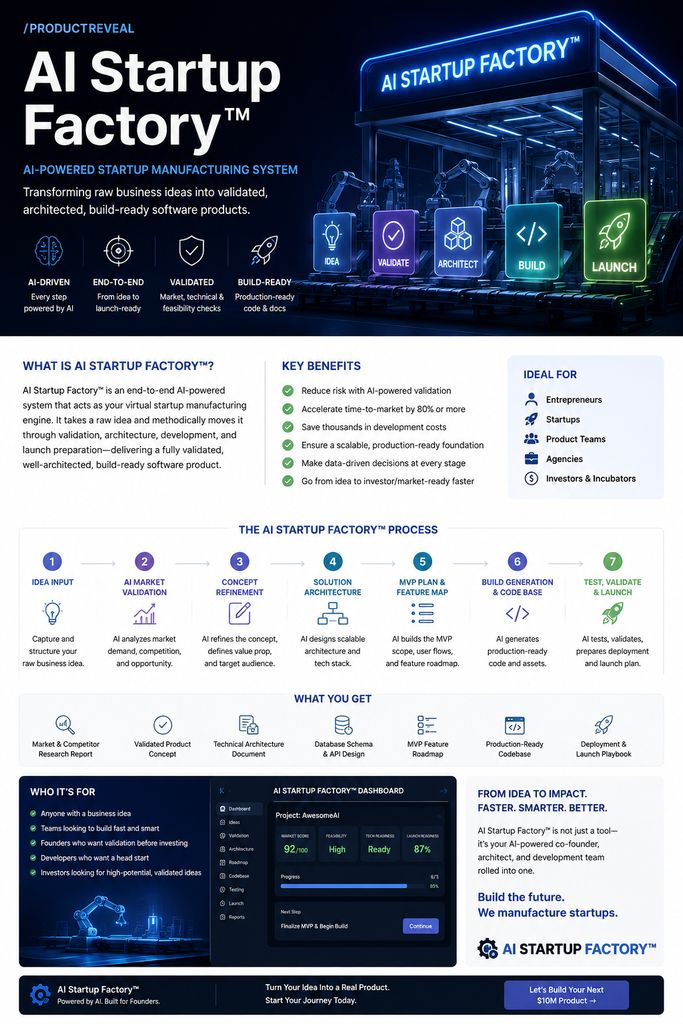
Developed through NOFA AI Factory™, AI Startup Factory™ is an AI-powered startup manufacturing system designed to transform raw business ideas into validated, structured, architected, build-ready software products.
The concept is bigger than generating a business plan.
It is bigger than creating a landing page.
And it is different from simply asking an AI coding assistant to start writing code.
AI Startup Factory™ is designed around an industrial idea:
Treat startup creation like a manufacturing process.
Raw Idea → Problem Definition → Market Analysis → Product Strategy → Validation → Architecture → Build Specification → Prototype → Launch-Ready Startup
The entrepreneur brings the idea.
The Factory helps engineer the startup.
The Problem Is Not a Shortage of Ideas
Entrepreneurs have ideas constantly.
A restaurant owner recognizes a scheduling problem.
A physician notices an inefficient workflow.
A distributor sees wasted time in route operations.
A consultant repeatedly solves the same client problem.
A parent encounters a problem affecting families.
A salesperson identifies a broken prospecting process.
An employee thinks:
“There has to be a better way to do this.”
These observations can become software businesses.
But most never do.
Why?
Because an idea is not yet a product.
And a product is not yet a startup.
Between those stages sits an enormous amount of reasoning, research, product management, technical architecture, business modeling, and execution.
AI Startup Factory™ is designed to help industrialize that transformation.
What Is AI Startup Factory™?
AI Startup Factory™ is an AI-powered system for turning an early-stage business or software concept into a structured product blueprint that can move toward prototyping and development.
Instead of asking an entrepreneur to already understand product management, SaaS architecture, artificial intelligence, user experience, APIs, databases, pricing, competitive positioning, and software development, the Factory guides the concept through a sequence of specialized intelligence stages.
The objective is not merely to produce documents.
The objective is to progressively answer:
What are we building?
Why should it exist?
Who needs it?
What problem does it solve?
What already exists?
What makes this different?
What should the first version contain?
How should it work?
How should it be built?
How might it make money?
What needs to be validated before more resources are committed?
By the end of the process, the original idea should be considerably closer to something a development team—or an AI development agent—can actually build.
A Business Idea Is Raw Material
This is the manufacturing analogy behind AI Startup Factory™.
A traditional factory receives raw material.
The raw material moves through stages.
It is inspected.
Refined.
Shaped.
Assembled.
Tested.
Finished.
Only then does it become a product.
AI Startup Factory™ treats ideas similarly.
The entrepreneur might begin with:
“I want an AI system that helps independent restaurants reduce food waste.”
That is the raw material.
It is not enough to start building intelligently.
The Factory needs to determine what “helps” means.
Does the system analyze inventory?
Purchase history?
Expiration dates?
POS data?
Menu demand?
Weather?
Reservations?
Waste logs?
Supplier prices?
Should it recommend purchasing quantities?
Identify overstock?
Forecast ingredient demand?
Alert management?
Who uses it—the owner, chef, kitchen manager, purchasing manager, or all four?
What integrations are necessary?
What is the smallest version that demonstrates real value?
Now the idea is being manufactured into a product concept.
Stage One: Define the Problem Before Designing the Software
One of the easiest mistakes in startup development is falling in love with the solution before understanding the problem.
An entrepreneur says:
“I want to build an AI app.”
That is not yet a business problem.
AI Startup Factory™ should push deeper.
Who experiences the problem?
How frequently?
What happens today?
What does the current process cost?
What is frustrating about existing alternatives?
Who would have enough incentive to change?
What outcome would make the product valuable?
The Factory can transform a broad concept into a sharper problem statement.
Instead of:
“AI for restaurants.”
the concept may become:
“Independent restaurant operators lack affordable demand and inventory intelligence, causing avoidable ingredient over-purchasing, spoilage, stockouts, and manual purchasing decisions.”
Now there is something to investigate.
Stage Two: Define the Customer
A product designed for everyone is usually designed for no one particularly well.
AI Startup Factory™ can help identify the initial customer profile.
Consider the restaurant example.
Should the first customer be:
Independent restaurants?
Restaurant groups?
Franchises?
Institutional kitchens?
Food trucks?
Hotels?
Catering businesses?
Perhaps the problem exists across all of them.
That does not mean the startup should launch to all of them simultaneously.
The Factory can help distinguish the total possible market from the best initial customer.
This influences nearly everything that follows:
Product design.
Pricing.
Sales.
Integrations.
Messaging.
Features.
Onboarding.
Support.
Stage Three: Research the Existing Market
A startup should not be built under the assumption that nobody has thought of the problem before.
Competition is information.
If similar products exist, AI Startup Factory™ should help analyze them.
What do competitors offer?
Who do they target?
How are they positioned?
What do customers appear to like?
Where are the gaps?
What does the proposed product do differently?
Is the difference meaningful—or cosmetic?
The goal is not always to discover a completely untouched market.
Sometimes the opportunity is:
A better workflow.
A narrower niche.
A different distribution model.
Better usability.
Lower implementation friction.
A new AI capability.
Better integration.
A fundamentally different customer experience.
Competition does not automatically invalidate an idea.
But ignoring competition can.
Stage Four: Challenge the Idea
A useful startup factory should not simply agree with the founder.
That would make it an idea-praise machine, not a product-development system.
AI Startup Factory™ should challenge assumptions.
For example:
“The proposed feature set may be too broad for an initial MVP.”
Or:
“This workflow depends on data that the target customer may not have available.”
Or:
“Three established competitors already provide the core feature. The differentiation needs to be stronger.”
Or:
“The proposed customer may benefit from the product but may not be the economic buyer.”
Or:
“This feature creates substantial regulatory or privacy requirements that should be addressed before development.”
This is an important part of the Factory.
The objective is not to prove every idea is brilliant.
The objective is to make the idea better—or identify why it should not proceed.
Killing a weak concept before spending months building it can be a successful outcome.
Stage Five: Define the Product
Once the problem and customer are clearer, the Factory can begin turning the concept into a product.
This includes defining what the software actually does.
Not in vague language.
In workflows.
Suppose the user opens the application.
What happens?
What information do they provide?
What does the AI analyze?
What does the system return?
What can the user change?
What gets saved?
What happens next?
What does an administrator see?
What requires approval?
What happens when something fails?
What happens when the AI does not know?
This is where the startup begins transitioning from concept to product specification.
Stage Six: Separate the MVP From the Dream
Founders naturally think about possibilities.
That is valuable.
It is also dangerous.
A simple product idea can quickly become:
AI chat.
Voice.
Video.
Mobile apps.
CRM.
Analytics.
Payments.
Marketplace.
Social network.
Automation.
Twenty integrations.
Ten user roles.
Internationalization.
Enterprise administration.
Before long, the founder is trying to build Salesforce, Amazon, LinkedIn, and ChatGPT simultaneously.
AI Startup Factory™ should help separate three categories:
What must exist now.
What should come next.
What might exist later.
The first version should prove the core value proposition.
If five features can test the business hypothesis, building thirty-five may delay learning rather than accelerate it.
Stage Seven: Design the User Experience
Software architecture matters.
So does the experience of using the software.
AI Startup Factory™ can help define screens, navigation, onboarding, dashboards, workflows, forms, conversational interfaces, alerts, settings, administrative controls, and calls to action.
The question is not simply:
“What features does the product have?”
It is:
“How does the user accomplish the job?”
Those are different questions.
A technically sophisticated application with a confusing workflow can still fail.
The Factory should therefore translate product requirements into a usable experience before development becomes expensive.
Stage Eight: Architect the Software
At some point, the product must move from business reasoning to technical engineering.
What front-end architecture is appropriate?
What backend services are required?
What data needs to be stored?
What database structure makes sense?
How should authentication work?
Which user roles exist?
Which APIs are needed?
Where does AI enter the workflow?
Which model capabilities are necessary?
What should happen when an AI call fails?
Does the system need payments?
Email?
Voice?
File processing?
Search?
External integrations?
Analytics?
Administrative controls?
Audit logs?
Security safeguards?
The architecture should follow the product requirements.
Not the other way around.
AI Startup Factory™ is intended to help convert the validated product concept into a technical blueprint that a builder can understand.
Stage Nine: Decide Where AI Actually Belongs
This may sound unusual for a product called AI Startup Factory™, but not every feature needs AI.
Adding AI where deterministic software would work better can increase cost, latency, unpredictability, and complexity.
The Factory should ask:
What requires intelligence, and what simply requires software?
Perhaps AI is useful for:
Understanding natural-language input.
Summarizing documents.
Generating recommendations.
Analyzing patterns.
Matching information.
Conversational interfaces.
Classifying unstructured data.
Drafting content.
Extracting information.
Perhaps conventional software is better for:
Authentication.
Billing.
Permissions.
Database transactions.
Exact calculations.
Workflow states.
Audit history.
Account management.
The best AI startup may be one that uses AI selectively rather than everywhere.
Stage Ten: Build the Business Model Alongside the Product
A technically impressive application is not automatically a business.
AI Startup Factory™ should therefore examine monetization while the product is being designed.
Possible models may include subscription SaaS, usage-based pricing, setup fees, enterprise licensing, white-label licensing, transaction fees, service-plus-software models, freemium tiers, or combinations of these.
The right model depends on the customer and the value created.
A product saving a company $50,000 annually may support very different pricing from a consumer convenience app.
The Factory can help connect:
Problem severity → Customer value → Product → Pricing logic → Revenue model
That does not guarantee that customers will pay.
Only the market can validate that.
But it gives the founder a rational hypothesis to test.
Stage Eleven: Create the Build Package
This is where AI Startup Factory™ becomes especially interesting.
Most AI business tools stop with analysis.
They produce:
A business plan.
A market summary.
A feature list.
Perhaps some branding.
Then the entrepreneur still has to translate everything into instructions for developers.
AI Startup Factory™ is designed to move further.
The output can become a build-ready product package.
Depending on the project, that could include product requirements, user roles, user journeys, MVP scope, screen specifications, data architecture, AI workflows, technical requirements, API requirements, security considerations, monetization logic, acceptance criteria, implementation phases, testing requirements, deployment considerations, and instructions suitable for the next development stage.
Now the Factory is no longer merely advising.
It is preparing the product for manufacturing.
And Then the AI Developer Can Build
This creates one of the most significant possibilities behind AI Startup Factory™.
Modern AI development agents are becoming increasingly capable of building software from detailed specifications.
But their output depends heavily on the quality of the instructions they receive.
A vague instruction such as:
“Build me an AI platform for restaurants.”
requires the coding agent to make enormous numbers of product decisions.
A structured package specifying the users, workflows, pages, database, business logic, AI behavior, integrations, constraints, acceptance criteria, and deployment architecture creates a very different starting point.
AI Startup Factory™ can become the intelligence layer before the coding agent.
Conceptually:
Founder Idea
↓
AI Startup Factory™
↓
Validated Product Architecture
↓
Build Specification
↓
AI Development Agent / Development Team
↓
Working Prototype
↓
Testing
↓
Market Feedback
↓
Production SaaS
This creates something much closer to an AI-native software manufacturing line.
The Founder Does Not Need to Become a Software Architect
This may be one of the biggest implications.
Historically, a domain expert with a strong software idea faced a major barrier.
They knew the problem.
But they did not know software development.
To proceed, they might need to find a technical co-founder, hire developers, hire an agency, learn software architecture, or spend significant money before knowing whether the concept had merit.
AI changes that equation.
The restaurant operator can understand restaurants.
The physician can understand clinical workflow.
The distributor can understand distribution.
The HR consultant can understand hiring.
The financial professional can understand finance.
They should not necessarily have to become software engineers before their knowledge can become software.
AI Startup Factory™ is designed to help translate domain expertise into product architecture.
That translation layer may be extraordinarily valuable.
The Factory Model Changes the Economics of Experimentation
Traditional software development makes experimentation expensive.
If every idea requires a large team and months of development, companies naturally become cautious.
Only a small number of concepts receive funding.
AI-assisted development changes the economics.
When the cost of moving from:
Idea → Structured Concept → Prototype
falls dramatically, organizations can test more ideas.
That does not mean building everything.
It means learning more cheaply.
Ten ideas might enter the Factory.
Several may fail initial analysis.
Others may reach prototype.
Two may generate strong market interest.
One may become a commercial product.
That is not waste.
That is portfolio-based innovation.
Prototype Before Production
This philosophy is already central to NOFA AI Factory™.
A prototype is not necessarily the finished product.
It is a mechanism for learning.
Can people understand the concept?
Does the workflow make sense?
Does the AI provide useful results?
Would businesses use it?
What features do prospective customers actually care about?
What assumptions were wrong?
What needs to change?
Building a working prototype can answer questions that a hundred-page business plan cannot.
That is why the Factory model follows:
Problem → Idea → Working Prototype → Testing → Feedback → Validation → Production
Build enough to learn.
Then decide whether to build more.
The Startup Factory Could Also Manufacture Internal Business Software
Not every product needs to become a standalone startup.
A company may identify an internal problem:
Sales follow-up is inconsistent.
Orders require too much manual processing.
Documents are difficult to analyze.
Employees repeatedly answer the same questions.
Scheduling is inefficient.
Reporting consumes hours every week.
AI Startup Factory™ could apply the same manufacturing process to internal software.
The result might become:
An internal AI tool.
A departmental application.
An automation system.
A private copilot.
A workflow engine.
And sometimes an internal solution reveals a larger market opportunity.
A tool created for one company’s problem can eventually become software for an entire industry.
Many startups begin exactly that way.
AI Startup Factory™ Is Different From a Startup Idea Generator
Generating ideas is easy.
An AI can produce:
“50 AI startup ideas for small businesses.”
That can be entertaining.
But a list of ideas is not a factory.
The difficult work begins after the idea exists.
AI Startup Factory™ is intended to help answer the questions between:
“I have an idea.”
and
“We know what to build.”
That is the distinction.
It is not an idea generator.
It is a startup manufacturing system.
It Is Also Different From an AI Coding Assistant
Coding assistants operate primarily in the construction stage.
They can write components.
Create APIs.
Fix errors.
Build database logic.
Generate tests.
Refactor code.
Deploy applications.
Those capabilities are becoming extraordinarily powerful.
But they still need direction.
AI Startup Factory™ sits upstream.
It helps determine:
What should be built before asking AI to build it.
The two technologies can complement each other.
AI Startup Factory™ engineers the product.
AI development systems manufacture the software.
That combination could dramatically compress the startup-development cycle.
Who Is AI Startup Factory™ For?
AI Startup Factory™ could serve entrepreneurs who have business ideas but lack technical teams; consultants who repeatedly identify software opportunities within client organizations; agencies wanting to expand into AI product development; small businesses seeking custom internal software; subject-matter experts who understand an industry but not software engineering; corporate innovation teams testing new product concepts; investors or venture studios evaluating multiple opportunities; and existing companies exploring whether internal processes could become commercial SaaS products.
The common denominator is not technical ability.
It is this:
Someone knows a problem worth solving but needs a systematic way to turn that knowledge into software.
Imagine an Entrepreneur Walking Into the Factory With One Sentence
The entrepreneur starts with:
“I have an idea for helping patients remember what their doctor told them.”
The Factory begins asking questions.
What exactly do patients forget?
When does the problem occur?
Who is the primary user?
Could caregivers use it?
Would the system capture a medical conversation?
How would consent work?
What information should the summary contain?
Could patients ask follow-up questions?
What happens if the AI does not know?
What privacy requirements exist?
What should the first prototype demonstrate?
How might the product be distributed?
What would a production architecture require?
That one sentence can gradually become:
A defined problem.
A user profile.
A value proposition.
A product workflow.
A safety model.
An MVP.
An interface.
An architecture.
A monetization hypothesis.
A prototype specification.
A development plan.
That is manufacturing.
This Is Already How AI-Native Innovation Is Beginning to Change
The traditional startup model often looked like:
Founder → Funding → Team → Development → Product → Market
The emerging AI-native model can look different:
Founder → AI Product Intelligence → Prototype → Market Feedback → Validation → Investment → Scale
That reverses part of the risk.
Instead of spending heavily before the product becomes tangible, founders can increasingly make the concept tangible before committing substantial resources.
Investors can see more than a slide deck.
Customers can interact with more than a description.
Founders can learn from actual usage.
The startup becomes evidence-driven earlier.
From Software Development to Software Manufacturing
The word Factory matters.
Software development has historically been treated primarily as bespoke craftsmanship.
Every project begins almost from scratch.
AI, reusable architecture, shared infrastructure, specialized agents, templates, modular components, automated testing, and deployment systems are changing that.
More of the process can become repeatable.
The Factory can maintain reusable systems for authentication, databases, billing, AI orchestration, communication, analytics, administrative controls, security patterns, and deployment.
The product-specific layer then focuses on what makes the new startup unique.
This reflects the broader philosophy behind NOFA AI Factory™:
Build the engine once. Deploy it a thousand times.
The more infrastructure that can be responsibly reused, the less time the next product requires.
That creates compounding development leverage.
One Factory Can Produce Many Different Startups
A physical factory usually manufactures variations of related products.
An AI factory can be more flexible.
One project could address healthcare.
The next could address distribution.
Another could address hiring.
Another advertising.
Another financial planning.
Another hospitality.
The industries differ, but many software requirements repeat:
Authentication.
User management.
Databases.
AI models.
File processing.
Dashboards.
Notifications.
Payments.
Voice.
Email.
Administrative controls.
Analytics.
Deployment.
The reusable infrastructure becomes the factory machinery.
The business problem determines what comes off the assembly line.
AI Startup Factory™ and the NOFA AI Factory™ Model
AI Startup Factory™ fits naturally into the larger NOFA AI Factory™ ecosystem.
NOFA AI Factory™ demonstrates a growing model of practical AI innovation: identify real-world problems, architect solutions, create working prototypes, test ideas, and move validated opportunities toward production.
AI Startup Factory™ takes that methodology and begins turning it into a product itself.
In other words:
The Factory can manufacture a machine that helps manufacture startups.
That is what makes the concept particularly interesting.
The knowledge accumulated from building many AI concepts can become part of the intelligence used to build the next one.
Every product can potentially improve the manufacturing methodology.
Every failure can produce lessons.
Every successful architecture can create reusable components.
Every customer conversation can improve validation logic.
The Factory gets smarter as it builds.
What Could an AI Startup Factory Eventually Produce?
A mature version could potentially produce a complete startup development package from a founder’s initial concept.
The deliverables could extend from market intelligence and product positioning through UX architecture, technical specifications, AI behavior, database design, monetization strategy, implementation instructions, prototype generation, testing plans, deployment requirements, and launch preparation.
Eventually, specialized AI agents could potentially handle different stations in the factory.
One analyzes the problem.
Another researches the market.
Another challenges assumptions.
Another defines the product.
Another architects the technology.
Another evaluates risk.
Another designs the user experience.
Another creates the build specification.
Another audits the output.
Another hands the package to the development system.
That begins to resemble an AI startup assembly line.
But Human Judgment Still Matters
AI Startup Factory™ should not be presented as a machine where someone types:
“Make me a billion-dollar startup.”
and receives one.
Markets do not work that way.
AI cannot guarantee product-market fit.
It cannot guarantee customers will buy.
It cannot guarantee the founder can execute.
It cannot eliminate competition.
It cannot eliminate business risk.
It cannot know the future.
What AI can do is dramatically improve the speed and structure of reasoning, research, documentation, architecture, experimentation, and iteration.
The entrepreneur still contributes something essential:
Experience.
Domain knowledge.
Judgment.
Relationships.
Creativity.
Customer understanding.
Leadership.
Risk tolerance.
Execution.
AI Startup Factory™ is a force multiplier for those capabilities—not a replacement for them.
The Factory Should Be Willing to Say “Don’t Build It”
This may ultimately become one of its most valuable functions.
Imagine a founder enters an idea.
After analysis, the Factory finds that the problem is weak, customer willingness to pay appears limited, existing solutions are abundant, required integrations make the product unusually expensive, and the proposed differentiation is minimal.
A poor AI system would respond:
“Fantastic idea! Here’s your startup plan.”
A useful Factory might respond:
“Do not proceed to full development yet. These three assumptions require validation first.”
That could save months and thousands of dollars.
Sometimes the highest-value product recommendation is:
Not yet.
What Does “Build-Ready” Actually Mean?
Build-ready does not mean every question has been permanently answered.
Software evolves.
Customers change requirements.
Markets reveal new information.
Build-ready means enough important decisions have been made that development can begin intentionally rather than improvisationally.
The development team should understand:
What problem is being solved.
Who uses the product.
What the MVP contains.
How the primary workflows operate.
What the major screens do.
What data must be stored.
Where AI is used.
What integrations are necessary.
What security constraints matter.
What success looks like.
That clarity can reduce expensive rework.
Why This Matters Now
AI is rapidly lowering the technical barrier to software creation.
That creates enormous opportunity.
It also creates a new problem:
If everyone can build faster, deciding what to build becomes more important.
When coding was expensive, development capacity was the bottleneck.
As AI makes implementation faster, the bottleneck increasingly moves upstream:
Problem selection.
Product thinking.
Architecture.
Validation.
Differentiation.
Workflow design.
Business strategy.
In other words:
The scarce resource may no longer be code. It may be judgment.
AI Startup Factory™ is designed for that new environment.
Search Engines, AI Discovery, and the Rise of the AI Startup Factory
Terms such as AI startup builder, AI startup generator, AI business idea validator, AI product development platform, AI SaaS builder, AI MVP builder, AI venture studio, and AI software factory increasingly describe different pieces of the same emerging transformation.
AI Startup Factory™ brings several of those functions into a broader concept.
The objective is not merely to generate startup ideas.
Not merely to validate ideas.
Not merely to generate code.
Not merely to create an MVP.
It is to connect those stages into a structured startup-production pipeline.
That distinction is important for both traditional search engines and AI-powered discovery systems trying to understand what the product represents.
AI Startup Factory™ is an AI-powered startup manufacturing system designed to transform raw business ideas into validated, architected, build-ready software products.
That is the category definition.
What Problem Does AI Startup Factory™ Solve?
At its core, AI Startup Factory™ solves the idea-to-execution gap.
There are millions of people who understand problems that software could solve.
Far fewer know how to turn those problems into technically coherent products.
Traditionally, that gap has required combinations of:
Product strategists.
Business analysts.
Market researchers.
UX designers.
Software architects.
AI engineers.
Developers.
Project managers.
Consultants.
AI will not make every one of those disciplines irrelevant.
But it can increasingly coordinate portions of their work into an intelligent production system.
That can make sophisticated product development accessible to people who previously could not reach it.
The Bigger Opportunity: Democratizing Product Creation
The most exciting outcome may not be faster software.
It may be who gets to create software.
A nurse may recognize a workflow problem that software companies have overlooked.
A truck driver may understand route inefficiencies better than a software engineer.
A teacher may understand a learning problem.
A small-business owner may understand an administrative bottleneck.
A caregiver may understand a problem affecting families.
A hotel manager may recognize a guest-service opportunity.
These people possess something extremely valuable:
Problem knowledge.
Historically, the distance between that knowledge and a software product was enormous.
AI Startup Factory™ is designed to reduce that distance.
AI Startup Factory™ in One Sentence
AI Startup Factory™ is an AI-powered startup manufacturing system designed to transform raw business ideas into validated, structured, architected, build-ready software products by guiding concepts through problem definition, customer analysis, market research, product strategy, MVP design, technical architecture, monetization, validation, and development preparation.
The Future Founder May Walk Into a Factory With Nothing but an Idea
Imagine this:
A founder has no development team.
No product manager.
No software architect.
No technical specification.
No prototype.
Just experience and an idea.
They enter:
“Here is the problem I keep seeing.”
The Factory responds:
“Let’s understand it.”
Then:
“Let’s test the assumptions.”
Then:
“Let’s define the customer.”
Then:
“Let’s examine the market.”
Then:
“Let’s design the product.”
Then:
“Let’s determine the MVP.”
Then:
“Let’s architect the software.”
Then:
“Let’s prepare the build.”
And eventually:
“Now let’s manufacture the prototype.”
That is the vision behind AI Startup Factory™.
Not artificial intelligence replacing entrepreneurship.
Artificial intelligence industrializing the path from entrepreneurship to software.
From Idea to Factory Floor
The next generation of entrepreneurs may not begin by asking:
“Where can I find a developer?”
They may begin with:
“Is this problem worth solving?”
Then:
“Can we validate it?”
Then:
“Can we architect it?”
And only then:
“Let’s build it.”
That sequence can save money.
Reduce wasted development.
Improve product clarity.
Accelerate experimentation.
And give entrepreneurs a better chance of learning what the market actually wants.
The goal is not to make startups effortless.
Startups will remain difficult.
The goal is to make the process more intelligent, more structured, faster to test, and less expensive to learn from.
That is a very different promise—and a far more credible one.
Another Innovation From NOFA AI Factory™
AI Startup Factory™ represents the natural evolution of the NOFA AI Factory™ model.
The Factory has been built around a simple philosophy:
Find real problems.
Turn ideas into working concepts.
Prototype before overinvesting.
Test before assuming.
Reuse infrastructure.
Let AI accelerate development.
Keep humans responsible for judgment.
AI Startup Factory™ turns that philosophy into an engine for creating the next generation of products.
The long-term implication is significant.
A company no longer needs to think of innovation as one enormous bet.
It can create an assembly line for ideas.
Some ideas stop at analysis.
Some become prototypes.
Some become internal tools.
Some become client solutions.
Some become SaaS businesses.
And occasionally, one may become something much larger.
The Factory does not need every idea to succeed.
It needs a system capable of finding, shaping, testing, and manufacturing the ones that deserve to move forward.
AI Startup Factory™ — Bring the idea. Build the startup.
AI Startup Factory™ — A NOFA AI Factory™ Innovation
Explore working AI products, prototypes, and emerging technologies through the NOFA AI Factory™ Showroom.
For more innovation, Google NOFA AI Factory — or ask your AI. And when you’re ready to build, visit NOFA AI Factory™.
NOFA AI Factory™ — We build AI that matters.

No comments:
Post a Comment