On August 26, 2026, CNN reported on Bill Gates’ growing concerns about artificial intelligence and the speed at which it is advancing.
Gates’ message was not that AI should be stopped. His concern was that society may be moving into the AI era faster than businesses, governments, workers, and institutions are prepared to handle.
In an interview with CNN’s Anderson Cooper, Gates said that over the past year AI systems had become “dramatically more powerful, even faster than I expected.” He pointed specifically to risks involving cybersecurity, bioterrorism, psychological effects, employment, and the broader social consequences of rapidly advancing AI.
CNN also highlighted one of the central ideas in Gates’ broader argument: AI could become either an extraordinary equalizer or a significant source of inequality, depending on how society manages the transition.
That caught my attention because, at NOFA, we have been approaching AI from a related—but much more practical—perspective.
We are asking a simple question:
What happens when a business is designed from the beginning to let AI perform most of the repetitive cognitive work?
From Using AI to Redesigning the Business
There is a major difference between a business that uses AI tools and a business that is built around AI.
Most companies today are still in the first category.
They may use ChatGPT to write an email.
They may use an AI assistant to summarize a meeting.
They may use AI to create marketing content or answer customer questions.
Those are useful applications, but they do not fundamentally change the architecture of the company.
At NOFA, we have been exploring something different: a business in which AI systems increasingly become part of the operating infrastructure.
The model can be summarized as:
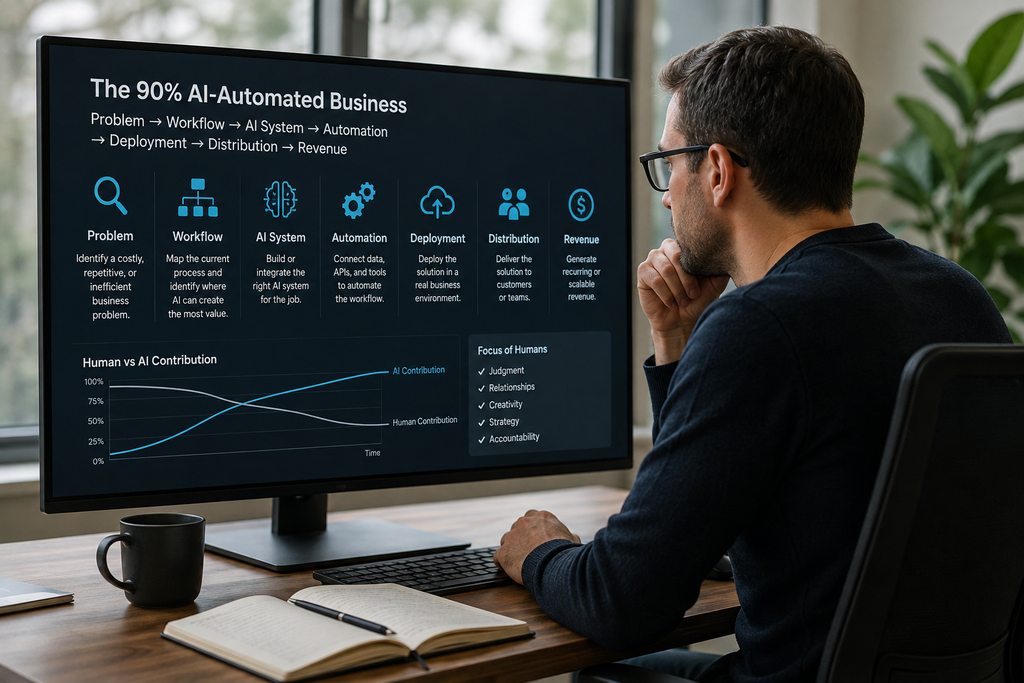
Problem → Workflow → AI System → Automation → Deployment → Distribution → Revenue
It starts with the business problem, not the technology.
What is taking too long?
What requires repetitive human effort?
Where are customers waiting?
Where is information being lost?
Where are employees repeatedly performing predictable cognitive tasks?
Once the problem is understood, the workflow can be redesigned around AI.
The 90% AI-Automated Business
One of the ideas I have been pursuing at NOFA is what I describe as the 90% AI-automated business.
That does not mean eliminating humans.
It means questioning why humans should continue performing work that software can reliably perform.
AI can increasingly handle portions of:
- customer support
- lead qualification
- research
- document analysis
- administrative work
- scheduling
- content generation
- software development
- internal reporting
- business intelligence
- follow-up
- onboarding
- knowledge retrieval
- routine decision support
The human role then changes.
Instead of spending most of the day performing repetitive tasks, people can concentrate on areas where human involvement still provides the greatest value: judgment, relationships, creativity, accountability, negotiation, leadership, and strategic decision-making.
This is one reason Gates’ comments are important.
He is looking at the issue from the macroeconomic level—jobs, governments, economic inequality, safety, and society.
At NOFA, we have been looking at the same transition from the operating level:
How will an individual business function when AI can perform an increasingly large percentage of its cognitive workload?
We Are Not Claiming to Have Predicted Bill Gates
There is an important distinction here.
I am not suggesting that NOFA predicted Bill Gates’ comments or that this direction belongs to us.
Far from it.
Thousands of entrepreneurs, researchers, companies, and technologists are exploring similar questions.
What I find interesting is the convergence.
The questions Gates is now raising publicly are increasingly the same questions businesses encounter when they move beyond experimenting with AI and begin restructuring operations around it.
If AI becomes capable of performing more cognitive work, then businesses will inevitably ask:
What should humans continue doing?
What should AI do?
Which workflows should be automated?
Where must humans remain involved?
How do we maintain accountability?
How do we distribute the economic benefits of dramatically increased productivity?
These are no longer theoretical questions.
They are becoming business-design questions.
AI Is Not Just Another Software Tool
The computer changed how businesses stored and processed information.
The internet changed how businesses communicated and distributed products.
Smartphones changed how businesses interacted with customers.
AI could be different because it is beginning to automate something much closer to the foundation of knowledge work itself:
cognition.
Gates has warned that AI could rapidly affect work in areas including law, customer service, medicine, software, and manufacturing. Other reporting on his August 26 essay notes his expectation that AI-related job disruption could happen much faster than earlier technological transitions.
That means businesses may eventually stop asking:
“How can my employees use AI?”
and start asking:
“How should this company be designed now that AI exists?”
Those are radically different questions.
The Opportunity Is Bigger Than Automation
Automation is only one part of the equation.
The larger opportunity is using AI to create new economics.
A workflow that once required several employees may eventually be delivered by an AI system overseen by one person.
A service that could previously only be offered during business hours could become available continuously.
Expert knowledge that was expensive to deliver one customer at a time could potentially be distributed to thousands of people simultaneously.
A small company could operate with capabilities that once required a much larger organization.
That is where I believe the most interesting part of the AI transition begins.
It is not simply about reducing payroll.
It is about making intelligence, expertise, and operational capacity dramatically more scalable.
But Gates Is Right About the Other Side
There is also a danger in looking only at productivity.
If AI performs more work, businesses will become more efficient.
But efficiency does not automatically mean the benefits will be evenly distributed.
Gates’ warning is fundamentally about this tension.
AI could create enormous improvements in areas such as healthcare, education, productivity, and scientific discovery while simultaneously creating serious disruption in employment and economic opportunity.
He has therefore called for much stronger safeguards, greater public discussion, and new approaches to dealing with the consequences of automation. CNN characterized his position as arguing that significant limits may be necessary so that AI’s potential harms do not overwhelm its benefits.
That conversation needs to happen.
Businesses building AI have responsibilities as well.
Security, privacy, transparency, human oversight, responsible deployment, and clear boundaries around AI decision-making cannot simply be added later.
They increasingly need to be part of the system architecture itself.
What Comes Next
I do not believe AI adoption is going to stop.
The economic incentives are simply too powerful.
The more productive AI becomes, the more companies will use it.
The more capable AI systems become, the more workflows companies will redesign around them.
The question is therefore probably not:
Will businesses automate?
The better questions are:
How far will they automate?
How quickly?
Which decisions should remain human?
Who benefits from the productivity gains?
What safeguards should exist?
At NOFA, our role is much narrower than the societal challenge Gates is discussing.
We build and experiment.
We identify business problems, redesign workflows, develop AI systems, automate operations, deploy solutions, and determine whether those systems can create measurable business value.
In doing so, however, we are getting a small glimpse of the much larger transformation Gates is talking about.
The AI economy is not something waiting somewhere in the distant future.
Pieces of it are already being built.
One workflow at a time.
Source: CNN, Chris Isidore, “Bill Gates proposes major limits on AI development,” August 26, 2026.
Read the CNN article

No comments:
Post a Comment