EcoForecast AI™: Turning Global Events Into Local Business Intelligence
A tariff changes thousands of miles away.
A major storm disrupts a manufacturing region.
A government introduces a new policy.
An election creates uncertainty around regulation, taxation, trade, or spending.
A geopolitical conflict affects energy markets.
A port closes.
Interest rates change.
A critical material suddenly becomes more expensive.
For a business owner, the important question is rarely just:
"What happened?"
The more important question is:
"What could this mean for my business?"
That question can be surprisingly difficult to answer.
News reports explain events at the national or global level. Economists discuss broad trends. Industry publications analyze particular markets. Government agencies publish enormous amounts of data.
But a manufacturer in Maryland, a retailer in Virginia, a distributor in Texas, and a professional-services company in California may experience the same global event very differently.
That is the problem EcoForecast AI™, developed by NOFA AI Factory™, is designed to address.
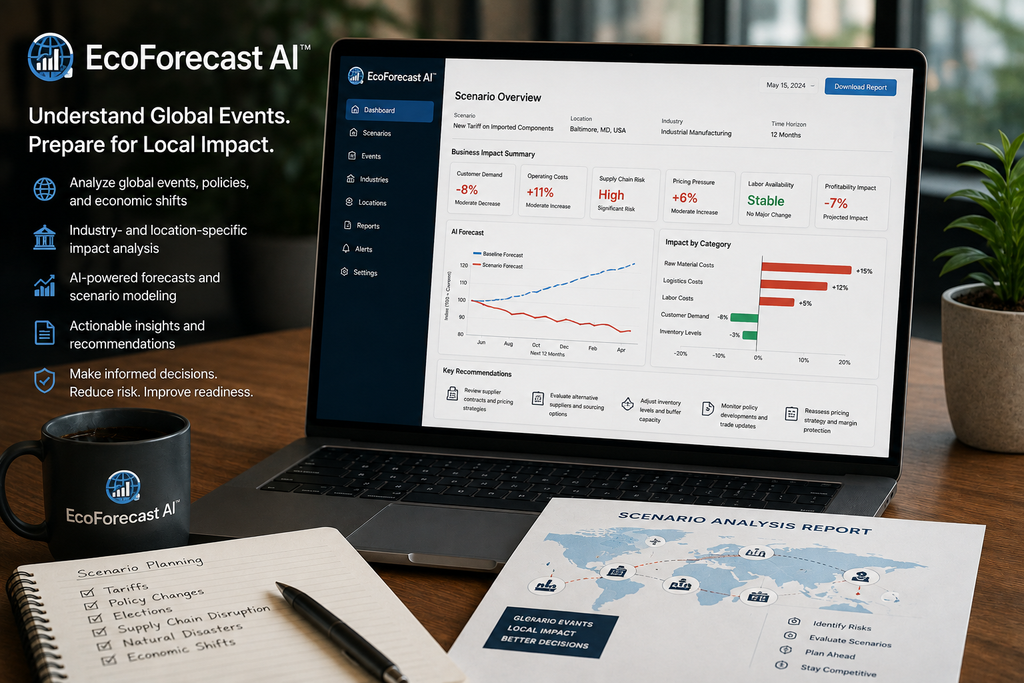
EcoForecast AI™ is an AI-powered business scenario analysis platform designed to help organizations understand how global events, government policies, economic changes, natural disasters, tariffs, elections, and geopolitical developments could affect their specific industry and local market.
It is designed to help businesses move from:
"Something important is happening."
to:
"Here is how it could affect us—and here are the areas we should consider preparing for."
What Is EcoForecast AI™?
EcoForecast AI™ is a business intelligence and scenario-planning platform.
A user provides three critical pieces of context:
The event or scenario.
The business location.
The industry.
EcoForecast AI™ then analyzes how that scenario could potentially affect areas such as:
- Customer demand
- Operating costs
- Supply chains
- Pricing
- Labor availability
- Transportation
- Inventory
- Materials
- Procurement
- Financing conditions
- Competitive dynamics
- Revenue
- Margins
- Overall profitability
The platform can then generate structured AI-assisted forecasts, business impact reports, scenario analyses, risk considerations, and actionable recommendations.
The goal is not to tell a business owner exactly what will happen.
The goal is to help the owner ask a much better question:
"If this happens, how should we prepare?"
The Problem: Businesses Are Affected by Events They Cannot Control
Every company operates inside a much larger economic system.
Even a local business is connected to global events.
A restaurant may purchase imported ingredients.
A contractor may depend on materials manufactured overseas.
A distributor may rely on fuel prices and transportation networks.
A retailer may sell imported products.
A manufacturer may depend on components from multiple countries.
A healthcare organization may face labor shortages or changing supply costs.
A government contractor may be affected by federal budgets, procurement priorities, regulations, and political changes.
A professional-services firm may depend heavily on the financial health of its clients.
The business owner may have no control over any of these external forces.
But the owner still has to make decisions because of them.
That is where economic intelligence becomes valuable.
Global Events Can Become Local Business Problems
Consider a hypothetical new tariff on imported steel.
At first glance, this sounds like a national trade-policy issue.
But follow the economic chain.
Imported steel becomes more expensive.
Domestic suppliers may adjust prices.
Manufacturers using steel experience higher input costs.
Construction companies may pay more for materials.
Equipment manufacturers may change pricing.
Distributors may face higher inventory costs.
Businesses purchasing those products may delay investments.
Customers may ultimately see higher prices.
One policy decision can move through multiple industries before eventually reaching a local business.
The challenge is understanding where your company sits in that chain.
EcoForecast AI™ is designed to help businesses examine those connections.
From News Event to Business Impact
Traditional news tells you what happened.
EcoForecast AI™ is designed to help explore what that event could mean operationally.
The process can be thought of as:
Event → Economic Effects → Industry Effects → Local Effects → Business Impact → Possible Response
That final step is critical.
Business owners do not simply need information.
They need decision context.
For example:
Should inventory levels change?
Could suppliers become more expensive?
Should pricing assumptions be reviewed?
Could customers postpone purchases?
Should another supplier be identified?
Could transportation costs rise?
Would hiring become easier or harder?
Should the company preserve additional cash?
Would certain products become more attractive?
Could the event create an opportunity rather than merely a risk?
EcoForecast AI™ is designed to help businesses think through those questions before conditions force them to react.
Understanding Customer Demand
External events can dramatically affect customer behavior.
Economic uncertainty may cause consumers to postpone discretionary purchases.
Interest-rate changes may influence real estate, construction, automotive purchases, and business investment.
Government spending changes can affect contractors.
Fuel-price changes can influence transportation-dependent industries.
A natural disaster may temporarily increase demand for certain products while reducing demand for others.
EcoForecast AI™ can help businesses examine how a particular scenario might affect customer demand within their industry and location.
The objective is not to produce a magical sales number.
It is to help management understand:
What forces could increase demand?
What forces could reduce it?
Which customers might be most affected?
How quickly could the impact occur?
What indicators should the business monitor?
Those questions can make planning considerably more useful.
Operating Cost Intelligence
Revenue is only half of the profitability equation.
A business can maintain sales and still experience financial pressure if operating costs rise.
External events can influence:
- Energy
- Fuel
- Insurance
- Transportation
- Materials
- Rent
- Financing
- Technology
- Labor
- Imported goods
- Equipment
- Packaging
- Utilities
EcoForecast AI™ can help identify which cost categories may be exposed under a particular scenario.
A distributor evaluating rising fuel prices, for example, may need to consider delivery costs and route profitability.
A manufacturer analyzing tariffs may need to examine raw materials and components.
A retailer may need to consider wholesale pricing and customer price sensitivity.
The same economic event creates different cost pressures for different businesses.
That is why industry context matters.
Supply Chain Risk Analysis
Recent years have demonstrated how vulnerable supply chains can be.
A company does not need to purchase directly from an affected country to experience disruption.
Its supplier may depend on that country.
Its supplier's supplier may depend on it.
A port disruption may delay components.
A natural disaster may affect manufacturing capacity.
A geopolitical conflict may affect shipping routes.
Trade restrictions may change sourcing economics.
EcoForecast AI™ can help businesses think through potential supply-chain consequences, including:
- Supplier exposure
- Material availability
- Lead-time changes
- Transportation risks
- Inventory requirements
- Alternative sourcing
- Pricing pressure
- Geographic concentration
- Potential bottlenecks
This can support a more proactive conversation with suppliers.
Instead of asking after the disruption:
"When will our order arrive?"
management can begin asking beforehand:
"Where are we vulnerable if this scenario develops?"
Tariff Impact Analysis
Tariffs provide an excellent example of why business-specific scenario analysis matters.
A tariff does not affect every company equally.
The impact depends on questions such as:
What products are covered?
Where does the business source its goods?
Does the company import directly?
Are domestic alternatives available?
Will competitors face the same cost increases?
Can higher costs be passed to customers?
How price-sensitive are those customers?
Will demand shift toward substitutes?
Could domestic producers benefit?
EcoForecast AI™ can help structure these questions into a business-impact analysis.
A tariff can be a threat to one company and an opportunity for another.
Good strategic intelligence should examine both possibilities.
Natural Disaster Scenario Planning
Natural disasters create immediate human consequences, but they can also create economic effects far beyond the affected area.
Hurricanes can disrupt ports and transportation.
Flooding can affect agriculture and manufacturing.
Wildfires can affect insurance, transportation, tourism, and local commerce.
Earthquakes can interrupt production and infrastructure.
Severe winter weather can delay shipments and disrupt labor availability.
EcoForecast AI™ can help businesses examine the secondary economic effects of these events.
A company hundreds of miles away may still be affected if a major supplier, transportation hub, customer market, or critical infrastructure point is located in the impacted region.
The relevant question becomes:
"How exposed is our business to this event?"
Elections and Government Policy
Elections can create significant business uncertainty.
But EcoForecast AI™ should not be used as a political prediction machine.
Its role is different.
The platform can help businesses evaluate policy scenarios.
For example:
What if corporate tax policy changes?
What if government spending increases in our industry?
What if environmental regulations become stricter?
What if procurement priorities change?
What if immigration policy affects labor availability?
What if new tariffs are introduced?
What if healthcare reimbursement rules change?
Instead of attempting to predict exactly who will win an election or what every politician will do, businesses can model different scenarios.
That is often more useful.
The company can ask:
Scenario A: What if the policy changes?
Scenario B: What if current policy remains?
Scenario C: What if implementation is delayed?
Then management can consider how each possibility affects the organization.
Geopolitical Risk and Business
Wars, diplomatic disputes, sanctions, shipping disruptions, energy conflicts, and trade restrictions can quickly move from international affairs into business operations.
A geopolitical event might affect:
- Energy prices
- Commodity prices
- Shipping routes
- Currency markets
- Imports
- Exports
- Technology access
- Manufacturing capacity
- Insurance
- Consumer confidence
Most small businesses do not employ geopolitical analysts.
Yet many are indirectly exposed to geopolitical risk.
EcoForecast AI™ is designed to make structured scenario analysis more accessible to organizations that may not have dedicated economic intelligence teams.
Labor Availability
Economic and policy changes can also affect labor markets.
A business may experience:
- Worker shortages
- Wage pressure
- Increased competition for talent
- Reduced hiring demand
- Geographic labor shifts
- Skills shortages
- Changes in seasonal labor
- Changes in employee expectations
EcoForecast AI™ can incorporate labor considerations into a broader scenario analysis.
For labor-intensive businesses, this may be as important as supply-chain or pricing analysis.
Pricing Intelligence
One of the hardest decisions during changing economic conditions is pricing.
If costs rise, should the business raise prices?
How much?
Will competitors do the same?
Will customers accept the increase?
Could demand decline?
Should the company absorb some of the cost?
Would a temporary surcharge make sense?
Should certain products be emphasized instead?
EcoForecast AI™ does not make the pricing decision for management.
It can help organize the forces surrounding that decision.
That is the distinction between decision support and automated decision-making.
Profitability Analysis
Ultimately, many external events converge on one question:
What could this do to profitability?
A scenario might increase revenue but also increase costs.
Another might reduce demand while simultaneously reducing labor pressure.
A tariff might hurt one product category while making another more competitive.
A government program might create new demand but require additional staffing.
EcoForecast AI™ is designed to help businesses consider these interconnected effects rather than analyzing every factor in isolation.
The platform can help management examine how changes in:
Demand + Pricing + Costs + Labor + Supply Chain + Operations
could combine to affect business performance.
Scenario Planning: One of EcoForecast AI™'s Most Important Capabilities
Business leaders frequently make the mistake of asking:
"What is going to happen?"
In uncertain environments, a better question may be:
"What are the reasonable possibilities, and what would we do under each one?"
That is scenario planning.
EcoForecast AI™ can support multiple scenarios.
For example:
Scenario A — Mild Impact
Costs increase slightly, supply remains available, and customer demand remains stable.
Scenario B — Moderate Impact
Costs rise significantly, lead times increase, and customers become more price-sensitive.
Scenario C — Severe Impact
Critical materials become difficult to obtain, prices rise sharply, and demand changes substantially.
Management can then consider a response to each.
That is more useful than relying on one supposedly perfect prediction.
Turning Scenario Analysis Into Action
Analysis without action has limited value.
EcoForecast AI™ is designed to generate actionable recommendations that businesses can evaluate.
Depending on the scenario, those recommendations might involve considering:
- Alternative suppliers
- Inventory adjustments
- Pricing reviews
- Cost controls
- Cash reserves
- Staffing plans
- Contract reviews
- Product mix changes
- Customer communication
- Geographic diversification
- Supplier discussions
- Contingency planning
- Monitoring specific indicators
These are not automatic instructions.
They are considerations for management.
The business remains responsible for deciding which actions are appropriate.
Who Can Use EcoForecast AI™?
EcoForecast AI™ can potentially support organizations across many industries because external economic conditions affect virtually every business.
Manufacturers
Manufacturers may be particularly exposed to tariffs, commodity prices, energy costs, components, labor availability, transportation, and international supply chains.
EcoForecast AI™ can help manufacturers explore how external events could affect production costs, sourcing, pricing, demand, and margins.
Distributors
Distributors operate at the intersection of inventory, transportation, suppliers, retailers, and customers.
Fuel prices, product availability, supplier pricing, labor costs, and changing consumer demand can all affect route and distribution economics.
EcoForecast AI™ can help distributors evaluate those pressures.
NOFA AI Factory™ is also developing FreshRoute AI™ around distribution operations, illustrating how external economic intelligence and internal operational intelligence can potentially complement each other.
Retailers
Retail businesses need to understand consumer demand, wholesale costs, inventory availability, pricing, imports, and local economic conditions.
A retailer could use scenario analysis to consider how an economic change might affect both purchasing costs and customer behavior.
Professional Service Firms
Consultants, accountants, agencies, insurance organizations, financial-service businesses, and other professional firms may not have physical supply chains, but they remain exposed to client spending, labor costs, financing conditions, and broader business confidence.
EcoForecast AI™ can help these organizations examine how economic changes may affect their client markets.
Healthcare Organizations
Healthcare organizations face labor pressures, supply costs, reimbursement changes, regulatory developments, demographic trends, and operational expenses.
Appropriate scenario analysis can help leadership explore the business and operational implications of changing external conditions.
Healthcare decisions require specialized professional, regulatory, financial, and clinical review; AI-assisted analysis should support—not replace—those processes.
Government Contractors
Government contractors are particularly exposed to policy, budgets, procurement priorities, regulations, agency spending, elections, and geopolitical developments.
A contractor may want to evaluate:
What happens if federal spending increases in our sector?
What if an agency's priorities change?
What if new domestic sourcing requirements appear?
What if tariffs affect our contract costs?
This makes EcoForecast AI™ potentially useful alongside procurement intelligence platforms such as JudyBid Analyze™, another innovation from NOFA AI Factory™.
Business Consultants
EcoForecast AI™ could also become a useful analytical tool for consultants.
A consultant advising clients on strategy can use scenario analysis to structure conversations around external risk.
Instead of providing only a general observation such as:
"Tariffs may affect your company,"
the consultant can examine the client's industry, location, costs, supply chain, customers, and potential responses.
That creates a much deeper strategic conversation.
Small Businesses Need Economic Intelligence Too
Large corporations employ economists.
They hire risk consultants.
They maintain strategy departments.
They purchase expensive market intelligence.
They conduct scenario planning.
Small businesses are affected by the same economy but often have none of those resources.
The owner watches the news and tries to determine:
"Is this going to hurt us?"
EcoForecast AI™ is based on the idea that sophisticated scenario thinking should become more accessible.
A small business may not need a team of economists.
But it can benefit from a structured way to ask:
What could happen?
How could it affect us?
Where are we exposed?
What should we monitor?
What could we do now?
EcoForecast AI™ Is Not a Crystal Ball
This is one of the most important principles behind the platform.
EcoForecast AI™ does not predict the future with certainty.
Neither can economists, financial markets, governments, consultants, or AI systems.
Unexpected events occur.
Policies change.
Human behavior changes.
Data can be incomplete.
Relationships between economic variables can change.
Therefore, EcoForecast AI™ should not be positioned as:
"Tell us exactly what will happen."
It is designed for:
AI-assisted scenario analysis.
That is a more responsible—and more useful—application of artificial intelligence.
Forecasting vs. Scenario Intelligence
There is an important distinction between a prediction and a scenario.
A prediction says:
"This will happen."
A scenario says:
"If this happens, these consequences may follow."
EcoForecast AI™ emphasizes the second approach.
That allows businesses to prepare for uncertainty without pretending uncertainty does not exist.
A management team can compare scenarios, evaluate potential responses, identify early warning indicators, and make more informed decisions.
The purpose is not certainty.
The purpose is preparedness.
Why Should a Business Use EcoForecast AI™?
A company should consider scenario intelligence when important decisions depend heavily on forces outside its control.
EcoForecast AI™ may be useful when a business is asking questions such as:
- Could this tariff affect our costs?
- Could this conflict disrupt our suppliers?
- How might an economic slowdown affect our customers?
- What would higher interest rates mean for our market?
- Could this policy change create an opportunity?
- Should we increase inventory?
- Should we diversify suppliers?
- Could labor become more expensive?
- How might this event affect our local market?
- What should we monitor over the next several months?
- What happens to our profitability under different assumptions?
These are strategic questions.
AI can help businesses analyze them faster and more systematically.
From Reactive Business Management to Prepared Business Management
Many companies react to economic changes only after the impact reaches them.
A supplier raises prices.
Then management responds.
Customers stop buying.
Then the business adjusts.
A shipment is delayed.
Then another supplier is sought.
Labor becomes scarce.
Then wages are reconsidered.
EcoForecast AI™ encourages a different approach:
Event → Analyze → Model → Prepare → Monitor → Adjust
The objective is not to eliminate surprises.
That is impossible.
The objective is to make the business less surprised and better prepared.
Why NOFA AI Factory™ Built EcoForecast AI™
NOFA AI Factory™ focuses on practical applications of artificial intelligence.
The development philosophy begins with a problem:
What decision is difficult because people cannot easily connect all the relevant information?
EcoForecast AI™ addresses exactly that kind of problem.
Business owners can read about tariffs.
They can read about elections.
They can read economic reports.
They can follow geopolitical events.
But translating all of that information into:
"What does this mean for my particular business?"
requires another layer of analysis.
EcoForecast AI™ is designed to provide that layer.
Part of the Growing NOFA AI Factory™ Ecosystem
EcoForecast AI™ joins a broader portfolio of specialized AI products and prototypes developed through NOFA AI Factory™.
The Factory includes technologies such as:
JudyVA™ — a customizable 24/7 AI business assistant.
JudyOps AI™ — an AI-powered operations assistant designed to help businesses capture requests, route work, monitor progress, and keep important tasks moving.
JudyBid Analyze™ — an AI-powered government procurement opportunity analysis platform.
IntelliScan AI™ — an AI website scanner designed to identify automation gaps and operational opportunities.
FreshRoute AI™ — an intelligent distribution operations platform.
Magazinify AI™ — an AI-powered digital publishing platform designed to turn business websites into professional magazines.
Physician Intelligence Copilot™ — an AI workflow assistant designed around the physician workflow.
NOFA Clinical Intelligence Ecosystem™ — a patient-centered hospital intelligence environment.
Explore these and other products in the NOFA AI Factory™ Showroom.
The industries and applications vary, but the development principle remains consistent:
Identify a real problem. Build an AI capability around it. Demonstrate it. Test it. Improve it.
Who Is Farhad Nasserghodsi?
Farhad Nasserghodsi is the founder of NOFA Business Consulting, LLC and founder and architect behind NOFA AI Factory™.
The relationship between business consulting and AI development is particularly relevant to a product such as EcoForecast AI™.
Economic events do not exist in isolation.
Their significance depends on business strategy, operations, customers, costs, geography, supply chains, and management decisions.
That requires both a business perspective and a technology perspective.
NOFA Business Consulting focuses on business problems and strategy.
NOFA AI Factory™ develops AI products, prototypes, SaaS platforms, and intelligent workflow solutions around problems where technology can create practical value.
EcoForecast AI™ represents that intersection:
Business strategy + external intelligence + AI-assisted scenario analysis.
A Different Kind of Business Intelligence
Traditional business intelligence often looks inward.
What were our sales?
What were our expenses?
Which products performed best?
How many customers did we acquire?
What happened last quarter?
Those questions are essential.
EcoForecast AI™ looks in another direction:
What is happening outside the company that could affect what happens inside the company?
That creates two complementary forms of intelligence:
Internal Intelligence: What is happening in our business?
External Intelligence: What is happening around our business?
A strong management team needs both.
From "What Happened?" to "What If?"
Most business reporting focuses on the past.
EcoForecast AI™ is designed to support thinking about possibilities.
What if tariffs rise?
What if fuel prices increase?
What if interest rates fall?
What if a major supplier region experiences a disaster?
What if government spending changes?
What if labor becomes harder to find?
What if customer demand weakens?
What if this global event creates a local opportunity?
Those two words—
What if?
—can lead to some of the most valuable conversations a business leadership team has.
EcoForecast AI™ in One Sentence
EcoForecast AI™ is an AI-powered business scenario intelligence platform that helps organizations analyze how economic changes, government policies, tariffs, elections, natural disasters, geopolitical developments, and other external events could affect customer demand, costs, supply chains, pricing, labor, and profitability within their specific industry and market.
Don't Try to Predict the Future. Prepare for It.
No business can control the economy.
No business can control geopolitical events.
No business can control the weather.
No business can control every government policy.
But businesses can control how they prepare.
They can ask better questions.
They can examine vulnerabilities.
They can evaluate alternatives.
They can develop contingency plans.
They can monitor warning signs.
And they can make decisions with a clearer understanding of the possibilities surrounding them.
That is the opportunity behind EcoForecast AI™.
Not a crystal ball.
Not certainty.
Not an AI claiming to know what happens next.
A strategic intelligence tool designed to help businesses think ahead.
The future will always contain uncertainty.
The objective is to make uncertainty something businesses can analyze, plan around, and prepare for rather than simply fear.
EcoForecast AI™ — A NOFA AI Factory™ Innovation
Global events. Local impact. Smarter business planning.
Explore EcoForecast AI™ and other practical AI innovations through the NOFA AI Factory™ Showroom.
Have questions about EcoForecast AI™, business AI, or a custom intelligence solution for your organization? Talk with Judy™.
For more innovation, Google NOFA AI Factory — or ask your AI.
And when you’re ready to build… visit: nofaaifactory.com
NOFA AI Factory™ — We build AI that matters.

No comments:
Post a Comment